上下文层次结构
DispatcherServlet 需要一个 WebApplicationContext(ApplicationContext 的一个扩展)用于其自身的配置。WebApplicationContext 链接到它所关联的 ServletContext 和 Servlet。它也绑定到 ServletContext,这样应用程序就可以使用 RequestContextUtils 上的静态方法来查找 WebApplicationContext,如果它们需要访问它的话。
对于许多应用程序来说,拥有一个单一的 WebApplicationContext 既简单又足够。也可以拥有一个上下文层次结构,其中一个根 WebApplicationContext 在多个 DispatcherServlet(或其他 Servlet)实例之间共享,每个实例都有自己的子 WebApplicationContext 配置。有关上下文层次结构功能的更多信息,请参阅 ApplicationContext 的额外功能。
根 WebApplicationContext 通常包含基础设施 bean,例如需要在多个 Servlet 实例之间共享的数据仓库和业务服务。这些 bean 可以被子 Servlet 专用的 WebApplicationContext 有效地继承和覆盖(即重新声明),子 WebApplicationContext 通常包含与给定 Servlet 局部的 bean。下图展示了这种关系。
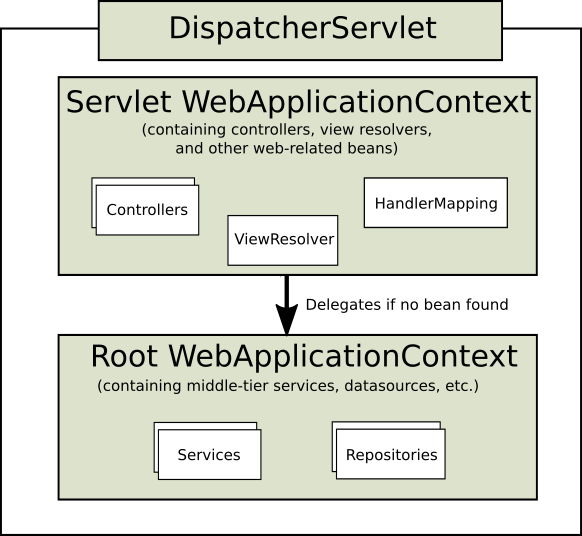
以下示例配置了 WebApplicationContext 层次结构。
-
Java
-
Kotlin
public class MyWebAppInitializer extends AbstractAnnotationConfigDispatcherServletInitializer {

	@Override
	protected Class<?>[] getRootConfigClasses() {
		return new Class<?>[] { RootConfig.class };
	}

	@Override
	protected Class<?>[] getServletConfigClasses() {
		return new Class<?>[] { App1Config.class };
	}

	@Override
	protected String[] getServletMappings() {
		return new String[] { "/app1/*" };
	}
}
class MyWebAppInitializer : AbstractAnnotationConfigDispatcherServletInitializer() {
override fun getRootConfigClasses(): Array<Class<*>> {
return arrayOf(RootConfig::class.java)
}
override fun getServletConfigClasses(): Array<Class<*>> {
return arrayOf(App1Config::class.java)
}
override fun getServletMappings(): Array<String> {
return arrayOf("/app1/*")
}
}如果不需要应用程序上下文层次结构,应用程序可以通过 getRootConfigClasses() 返回所有配置,并通过 getServletConfigClasses() 返回 null。 |
以下示例显示了等效的 web.xml 配置。
<web-app>

	<listener>
		<listener-class>org.springframework.web.context.ContextLoaderListener</listener-class>
	</listener>

	<context-param>
		<param-name>contextConfigLocation</param-name>
		<param-value>/WEB-INF/root-context.xml</param-value>
	</context-param>

	<servlet>
		<servlet-name>app1</servlet-name>
		<servlet-class>org.springframework.web.servlet.DispatcherServlet</servlet-class>
		<init-param>
			<param-name>contextConfigLocation</param-name>
			<param-value>/WEB-INF/app1-context.xml</param-value>
		</init-param>
		<load-on-startup>1</load-on-startup>
	</servlet>

	<servlet-mapping>
		<servlet-name>app1</servlet-name>
		<url-pattern>/app1/*</url-pattern>
	</servlet-mapping>

</web-app>
如果不需要应用程序上下文层次结构,应用程序可以只配置一个“根”上下文,并将 contextConfigLocation Servlet 参数留空。 |

